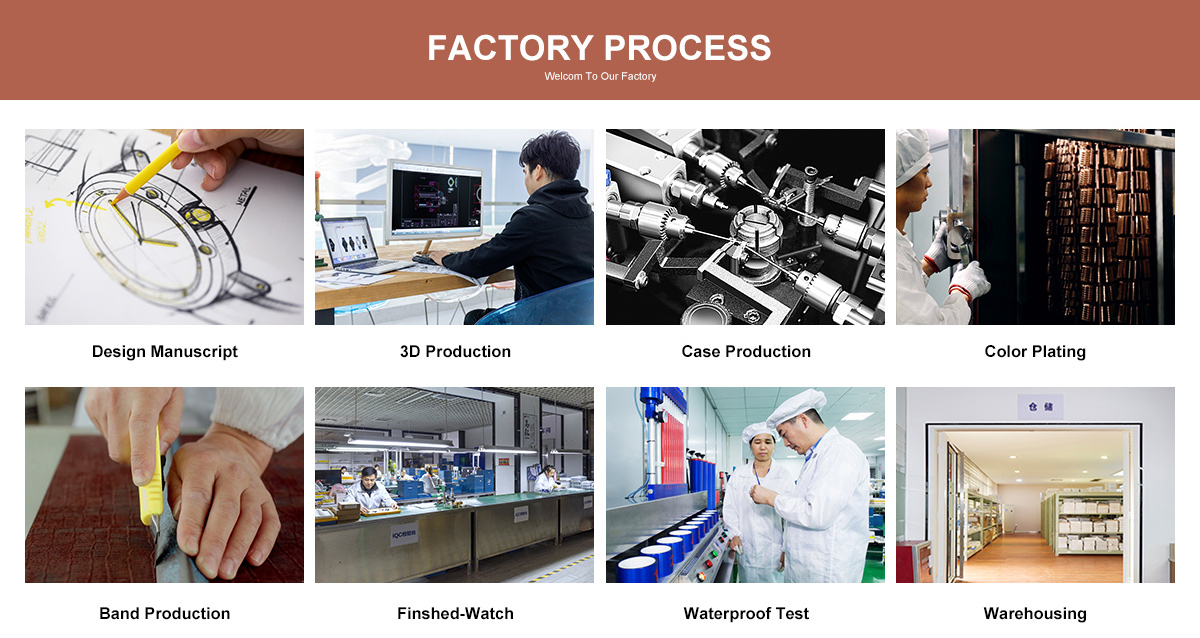
The creation of a wristwatch is a remarkable fusion of centuries-old craftsmanship, precision engineering, and modern technology. Whether it’s a mass-produced quartz watch or a hand-finished mechanical masterpiece, the journey from a designer’s sketch to a functioning timepiece on your wrist is a complex and fascinating process. This article breaks down the key stages of watch production.
1. Design and Conception
Every watch begins with an idea. The design phase involves:
Creative Design: Designers create sketches and digital renderings, defining the watch’s aesthetics—case shape, dial layout, hand design, and bracelet style.
Technical Design: Engineers take over to transform the concept into a viable product. They design the internal movement (caliber), specify tolerances (often within microns), select materials (e.g., stainless steel, titanium, sapphire crystal), and plan the assembly process.
Prototyping: A physical prototype is built, often using 3D printing or CNC machining. This allows the team to test the look, feel, ergonomics, and functionality before committing to full-scale production.
2. Component Manufacturing
A single watch comprises dozens, sometimes hundreds, of tiny components. These are produced through various high-precision methods:
Stamping: For larger, flatter parts like base plates and bridges, sheets of metal are stamped using custom-made dies.
CNC Machining: Computer Numerical Control (CNC) machines are the backbone of modern watchmaking. They use computer-guided drills and cutters to mill complex components like cases, bezels, and movement parts from blocks of metal with incredible accuracy.
Turning: Used for creating screws, pins, and axles on automatic lathes.
Electro-erosion: For extremely hard metals or intricate shapes that are difficult to machine, a wire uses electrical discharges to cut the material with precision.
Injection Molding: Used for plastic components in quartz movements or certain gaskets.
3. Surface Treatment and Finishing
Before assembly, components undergo various finishing processes:
Polishing and Brushing: Cases and bracelets are polished to a high shine or brushed for a matte finish, often by hand.
Plating: Components can be electroplated with gold, rose gold, or black PVD/DLC coatings for color and durability.
Decorative Finishing: High-end watches feature exquisite decorations like:
Côtes de Genève (Geneva Stripes): Wave-like patterns on bridges.
Perlage: Circular graining on the mainplate.
Bevelling: Polishing the angled edges of components.
Bluing: Screws and hands are heated to a specific temperature to achieve a vibrant blue color.
4. The Heart: Movement Production
This is where the paths for quartz and mechanical watches diverge significantly.
A. Quartz Movement Production:
Quartz movements are predominantly machine-made in large volumes. The process is highly automated:
The integrated circuit (the “brain”) and the stepper motor are manufactured or sourced.
The quartz crystal is tuned to vibrate at 32,768 Hz.
All components are assembled on automated production lines.
The movement is calibrated and the battery is installed.
B. Mechanical Movement Production:
This is the pinnacle of watchmaking art, involving both machine and hand work.
Assembly: Watchmakers, often using tweezers and screwdrivers under a microscope, meticulously assemble the movement: mainplate, gears, springs, and the escapement.
Installing the Escapement: This includes the balance wheel, hairspring, and pallet fork—the “heartbeat” of the watch.
Regulating: The watch is tested in different positions and temperatures. A regulator adjusts the hairspring to ensure accuracy, a process known as “timing.”
5. “Établissage” – The Assembly Line
This French term describes the final assembly process, which is often a hybrid of automated stations and skilled watchmakers.
Case Assembly: The crystal, case back, and crown seals (gaskets) are fitted to ensure water resistance.
Movement Casing: The completed movement is carefully placed into the case.
Dial and Hand Fitting: The dial is secured, and the hour, minute, and seconds hands are pressed onto their respective pivots with exact pressure.
Bracelet/Strap Attachment: The final bracelet or strap is fitted to the case lugs.
6. Quality Control and Testing
No watch leaves the factory without rigorous testing.
Timing Accuracy: The watch is measured by a microphone-based machine that listens to the tick rate to ensure it falls within specified tolerances (e.g., -4/+6 seconds per day for a COSC-certified chronometer).
Water Resistance: Watches are tested in pressurized tanks to simulate their rated depth.
Functionality Check: All complications (date, chronograph, etc.) are tested for correct operation.
Visual Inspection: A final, thorough check for any dust, scratches, or imperfections.
Conclusion
The production of a watch is a testament to human ingenuity. From the automated, precise lines of a quartz watch factory to the serene, focused benches of a master watchmaker assembling a grand complication, the process is a dedicated pursuit of
